Water does not fall straight down
This is the part almost everybody gets wrong, and it is the reason so many roof repairs fail. Water comes in through a gap somewhere on the roof, hits the underside of the plywood, and then runs. It follows the slope of the deck until it reaches a rafter, then follows the rafter, then soaks into insulation and spreads further still. It drops through the ceiling at whatever point along that path happens to be lowest.
The distance is not small. Eight or ten feet is normal. On a long rafter run it can be more than that, and on a cathedral ceiling where the water gets into a bay and travels the whole length before finding a seam, it can be much more.
What this means for you: if a contractor climbs up, looks at the shingles directly above your stain, and tells you the roof is fine, they have not looked for the leak. They have looked at the one place it almost certainly is not.
The eight places water actually gets in
Roughly in the order we find them. Notice what is not on this list: holes in the middle of the roof. Leaks happen at transitions and penetrations, not in the open field of shingles.
Chimney flashing
The most common source we find, and it is not close. Step flashing woven into the shingle courses, counter-flashing set into the mortar joints, and a cricket on the high side of anything wide. Any one of the three failing lets water in.
Step flashing at dormers and walls
Wherever a roof plane dies into a vertical wall. Each shingle course gets its own piece of L-shaped metal. Installers in a hurry run one long strip instead, and that strip funnels water behind the siding within a few years.
Pipe boots
The neoprene collar around a plumbing vent cracks in ten to fifteen years, long before the shingles do. Cheap to fix, easy to miss, and invisible from anywhere but directly overhead.
Valleys
Where two roof planes meet, all the water from both goes through one channel. Debris packs in, the metal corrodes, or the shingles were woven badly. Valleys carry more water per square foot than anywhere else on a roof.
Skylight curbs
The glass is almost never the problem. The flashing kit around the curb is, especially where a previous installer substituted caulk for the head flashing.
Nail pops and exposed fasteners
Nails back out as the deck moves through freeze and thaw cycles. The head lifts the shingle above it and opens a path. A ridge cap fastened with exposed nails and a dab of sealant is a leak on a timer.
Ice dams
A winter-only leak. Heat escaping the attic melts snow above the heated part of the house, it refreezes over the cold overhang, and the dam pushes water backward under the shingles. The roof is not failing. The insulation is.
Wind-driven rain at the ridge
A nor easter pushing rain sideways can drive water up under a ridge vent that handles ordinary rain without any trouble. Shows up only in severe storms, which is exactly why it gets misdiagnosed.
What a chimney leak looks like once the shingles come off
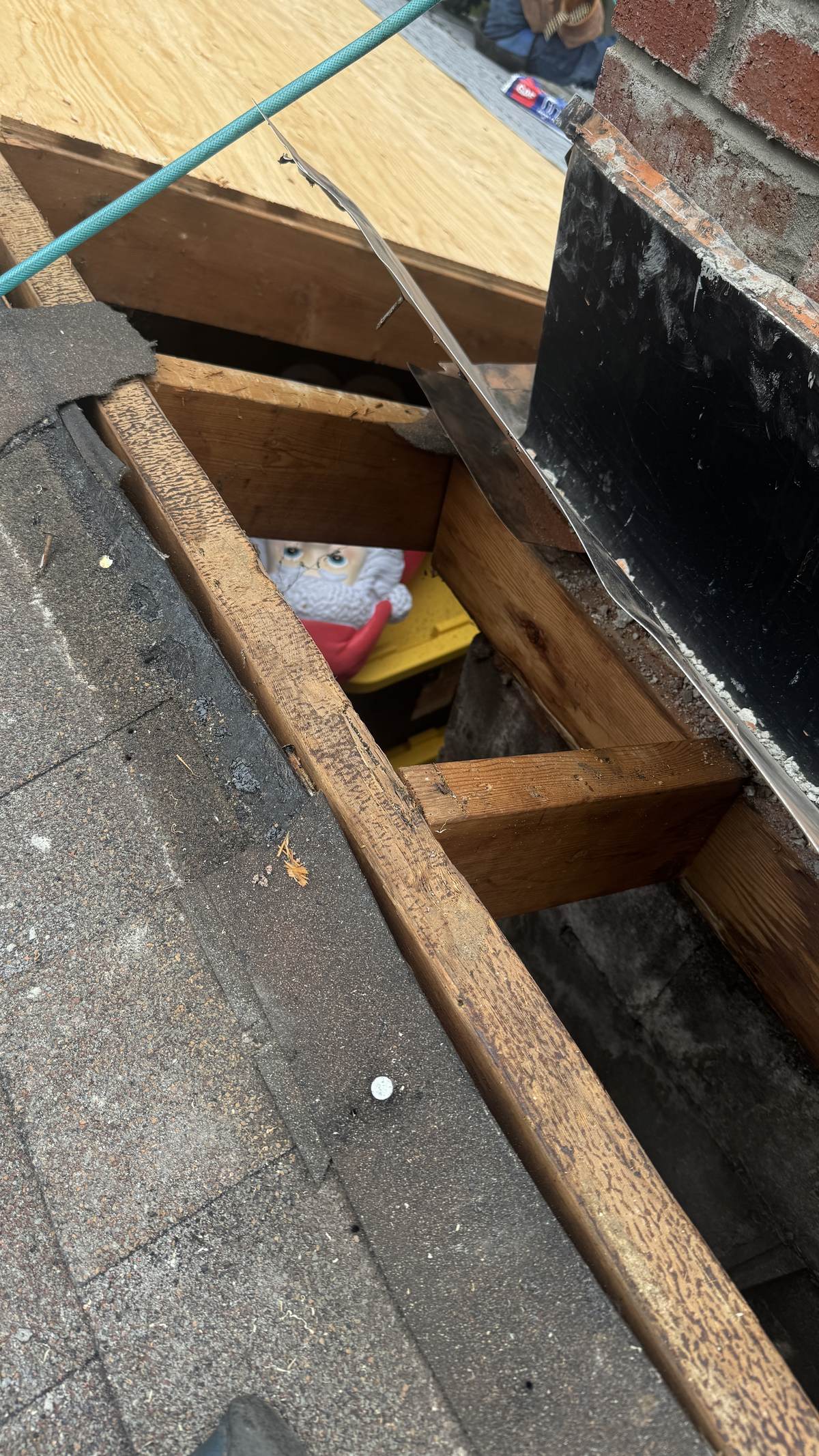
The homeowner had a stain in a bedroom ceiling and had been told twice it was a bad shingle. The water was coming in at the chimney and running down the deck before dropping.
By the time a flashing leak announces itself on your ceiling, it has usually been running for more than one season. The sheathing under the shingles goes soft first, and nothing about that is visible from the outside. That is the argument for finding the entry point early rather than sealing the symptom and waiting.
Sometimes it is not a leak at all
A meaningful share of the calls we take about roof leaks turn out to be something else. It matters, because a new roof does not fix any of these and you will be back where you started with a much bigger invoice.
- Attic condensation. Shows up in cold weather instead of during rain, spread over a wide area instead of one path.
- A bath fan or dryer venting into the attic. Warm wet air straight onto cold plywood. Extremely common in older homes here.
- Blocked soffit vents. Insulation stuffed tight against the eaves kills the airflow the roof needs.
- An air conditioning condensate line. Attic air handlers drip, and the stain looks exactly like a roof leak.
- A plumbing leak in a wall or second-floor bathroom. If the stain appears when nobody has run water and it has not rained in a week, look at the plumbing.
The tell is timing. A roof leak tracks the weather. Condensation tracks the temperature. Plumbing tracks whoever is using the shower.
What you can check before you call anybody
None of this requires getting on the roof, and please do not get on the roof. Five minutes with a flashlight in the attic tells a contractor more than an hour of guessing from the ground.
Write down when it happens
Every rain, or only heavy rain? Only when the wind comes from one direction? Only in winter? Only after snow? That pattern narrows the list faster than anything else.
Look in the attic with a flashlight
Find the dark staining on the underside of the plywood and follow it uphill. The highest wet point is closest to the entry. Take a photo.
Note what is above the stain outside
Chimney, dormer, skylight, vent pipe, valley? Anything penetrating the roof uphill of the stain is a suspect before the shingles are.
Check the gutters above it
A gutter overflowing backward against the fascia soaks the roof edge and imitates a leak convincingly. Water behind the gutter is a different problem with a cheaper fix.
Why “we will just seal it up” is the wrong answer
Roofing cement has a real job, and that job is buying you a dry night during a storm. Spread across a flashing joint as a permanent fix, it cracks. Usually within two or three winters, because it expands and contracts at a different rate than the metal underneath it and the bond gives up at the edges.
It also makes the eventual real repair more expensive. The cement has to come off the flashing before anything can be done properly, and that is slow, ugly work that somebody is going to bill you for.
If you see black tar smeared around your chimney, your skylight, or your pipe boots, somebody has already been there and taken the shortcut. The leak is not fixed. It is scheduled.
Roof leak questions
Why is the water stain on my ceiling not under the hole in my roof?
Because water travels. It enters at a gap in the flashing or a failed seal, runs down the underside of the roof deck, then follows a rafter until something stops it. It only drops through the ceiling at the low point of that path. On a typical roof the stain can appear eight or ten feet from the actual entry point, and on a long rafter run it can be further. This is the biggest reason homeowners misdiagnose their own leaks, and it is why chasing the stain almost never finds the problem.
What is the most common cause of a roof leak?
Chimney flashing, by a wide margin. The chimney is a masonry structure passing through a roof plane, and the only thing keeping water out of that gap is a layered flashing assembly: step flashing woven into the shingle courses, counter-flashing set into the mortar joints, and on wider chimneys a cricket on the high side to divert water around it. Any one of those failing lets water in. Roofing cement smeared over the joint is the usual previous repair, and it cracks within a couple of seasons.
Can a roof leak without any visible damage to the shingles?
Yes, and it is common. Most leaks we trace are not holes in the field of the roof. They are failures at transitions and penetrations: flashing, valleys, pipe boots, skylight curbs, and the joint where a dormer wall meets the roof plane. The shingles around those points can look perfect from the ground. If someone tells you the roof looks fine from the driveway, that is not an inspection.
How long do rubber pipe boots last?
The neoprene collar on a standard pipe boot typically cracks somewhere between ten and fifteen years, well before the shingles around it are finished. Sun exposure hardens the rubber until it splits where it grips the pipe. It is one of the cheapest repairs on a roof and one of the most frequently missed, because the crack is small and you cannot see it from anywhere except directly above it.
Is it condensation or a roof leak?
A few things point to condensation rather than a leak. It shows up in cold weather rather than during rain. The moisture is spread across a wide area of the sheathing instead of running down one path. There is frost or beaded water on the underside of the deck on cold mornings. The usual causes are a bathroom or dryer vent discharging into the attic instead of through the roof, blocked soffit vents, or insulation packed tight against the eaves and cutting off airflow. We check for all of that before quoting roof work, because replacing a roof does not fix a ventilation problem.
Should I let a contractor seal my leak with roofing cement?
Only as a deliberate temporary measure, and only if they tell you that is what it is. Roofing cement and caulk have a place in an emergency at ten at night in the rain. As a permanent repair they fail, usually within two or three seasons, and they make the real repair harder because the cement has to be cleaned off the flashing first. A contractor whose answer to a flashing leak is a tube of tar is either rushing or hoping you call someone else next time.
How do you actually find where a roof is leaking?
From the inside first. We go into the attic, find the wet sheathing, and follow the water back uphill along the rafter to the highest point where the deck is stained. That tells us roughly where on the roof to look. Then we inspect that area from above: flashing, fasteners, the seal on any penetration, and the condition of the deck around it. If the path is unclear, a controlled water test with a hose, working from the bottom of the suspected area upward one section at a time, will reproduce it. What we do not do is guess from the driveway.
Related
Water coming in right now? Emergency roof repair.
Storm just came through? Storm damage roof repair.
Trying to decide whether to patch it or replace it? Repair or replacement.
All articles
Find the leak, not the stain
We trace it from the attic before we quote anything, and we tell you if it turns out not to be the roof. Morris, Somerset, Essex, Passaic, and Bergen counties.
201-396-5509American Sons Professionals · GAF Master Elite® · NJ HIC #13VH09666100