Roof leaking right now? Do these four things first
Do this before anyone gets to you. It limits the damage and protects your insurance claim. None of it requires going on the roof — and you should not go on the roof in a storm.
Get the water under control inside
Move furniture and electronics clear. Put a bucket under the drip. If the ceiling is bulging with trapped water, poke a small hole at the lowest point of the bulge with a screwdriver and let it drain into the bucket — a controlled hole is far cheaper than a ceiling that collapses on its own.
Kill power to any wet area
If water is anywhere near light fixtures, ceiling fans, or outlets, shut that circuit off at the panel. Do not stand in standing water to do it.
Photograph everything before you clean up
Wide shots and close-ups: the ceiling, the walls, soaked insulation, ruined belongings, and the outside of the house if you can do it safely from the ground. Timestamps matter. This is the single most valuable thing you can do for your claim, and it takes two minutes.
Call a roofer, not a general handyman
A tarp installed wrong does nothing, or channels water somewhere worse. Ask whoever you call whether they are licensed and insured in New Jersey before they come out. Ours is NJ HIC #13VH09666100.
Then call 201-396-5509. Tell us whether water is entering living space — that is how we decide who we get to first when the whole county calls at once.
What we handle on an emergency call
Emergency tarping
Reinforced tarp fastened into sound framing and sealed at the edges so it survives the next round of wind instead of peeling off overnight.
Active leak tracing
Water rarely enters where it shows up. We trace it back to the real entry point — valley, flashing, pipe boot, skylight curb, or nail pop — instead of shingling over the stain.
Chimney flashing leaks
One of the most common causes of a leak people assume is a failed roof. Step flashing, counter-flashing, and cricket details are our everyday work.
Wind and storm damage
Blown-off shingles, lifted ridge caps, torn drip edge, and exposed decking secured and dried in. See our storm damage and insurance page below.
Tree and branch impact
We secure the opening, assess whether decking or rafters are compromised, and give you a straight answer about repair versus replacement.
Ice dams and winter leaks
North Jersey freeze-thaw cycles push water backward under shingles. We relieve the dam and address the ventilation problem underneath it.
What a proper emergency dry-in looks like
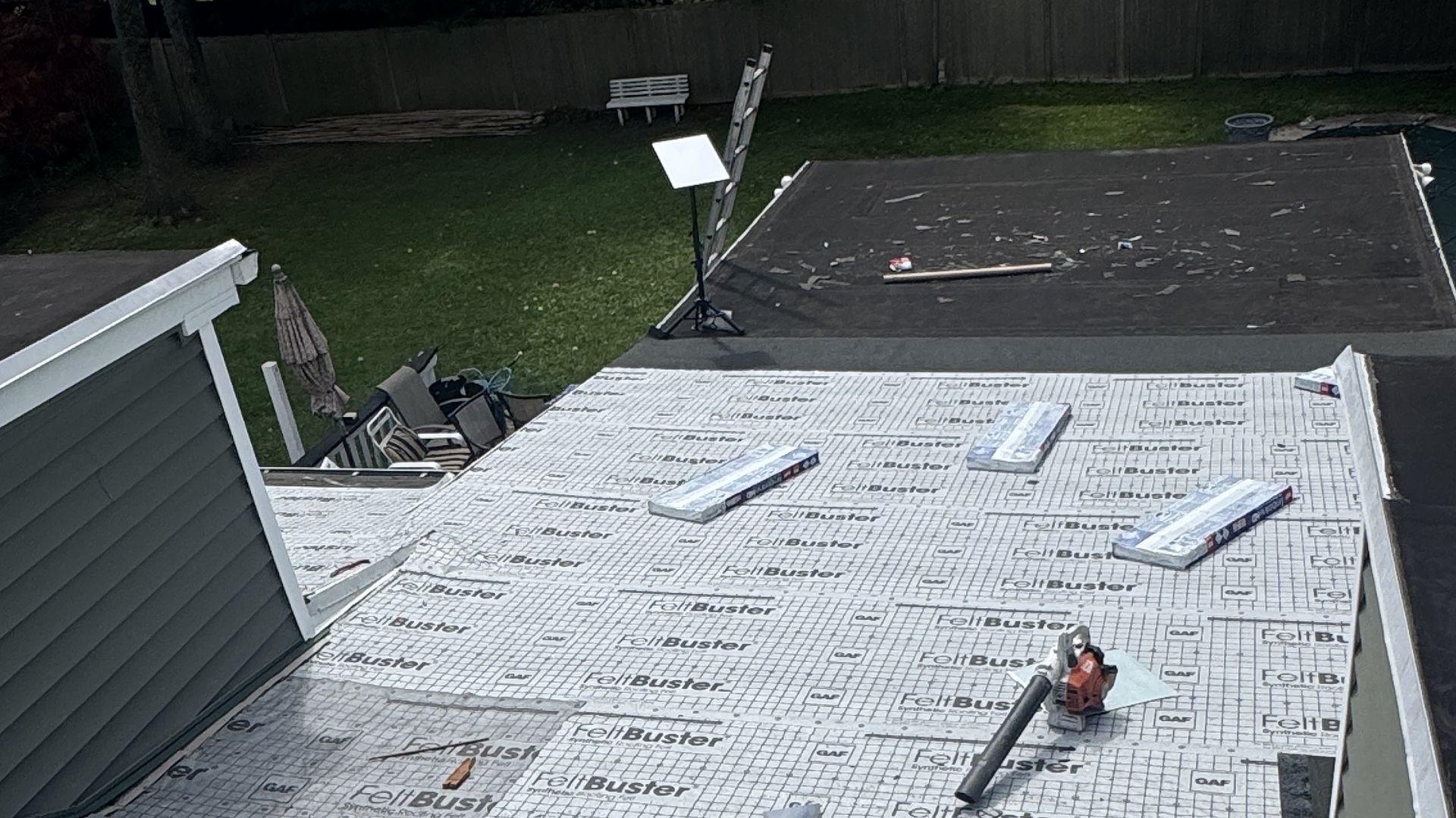
This is a North Jersey roof stripped to the deck and dried in with GAF FeltBuster synthetic underlayment, with cap nails and lapped seams, before a single shingle goes on. Underlayment like this is what actually keeps the house dry between tear-off and finish. A crew that leaves felt loose, under-fastened, or open at the seams overnight is gambling with your ceilings.
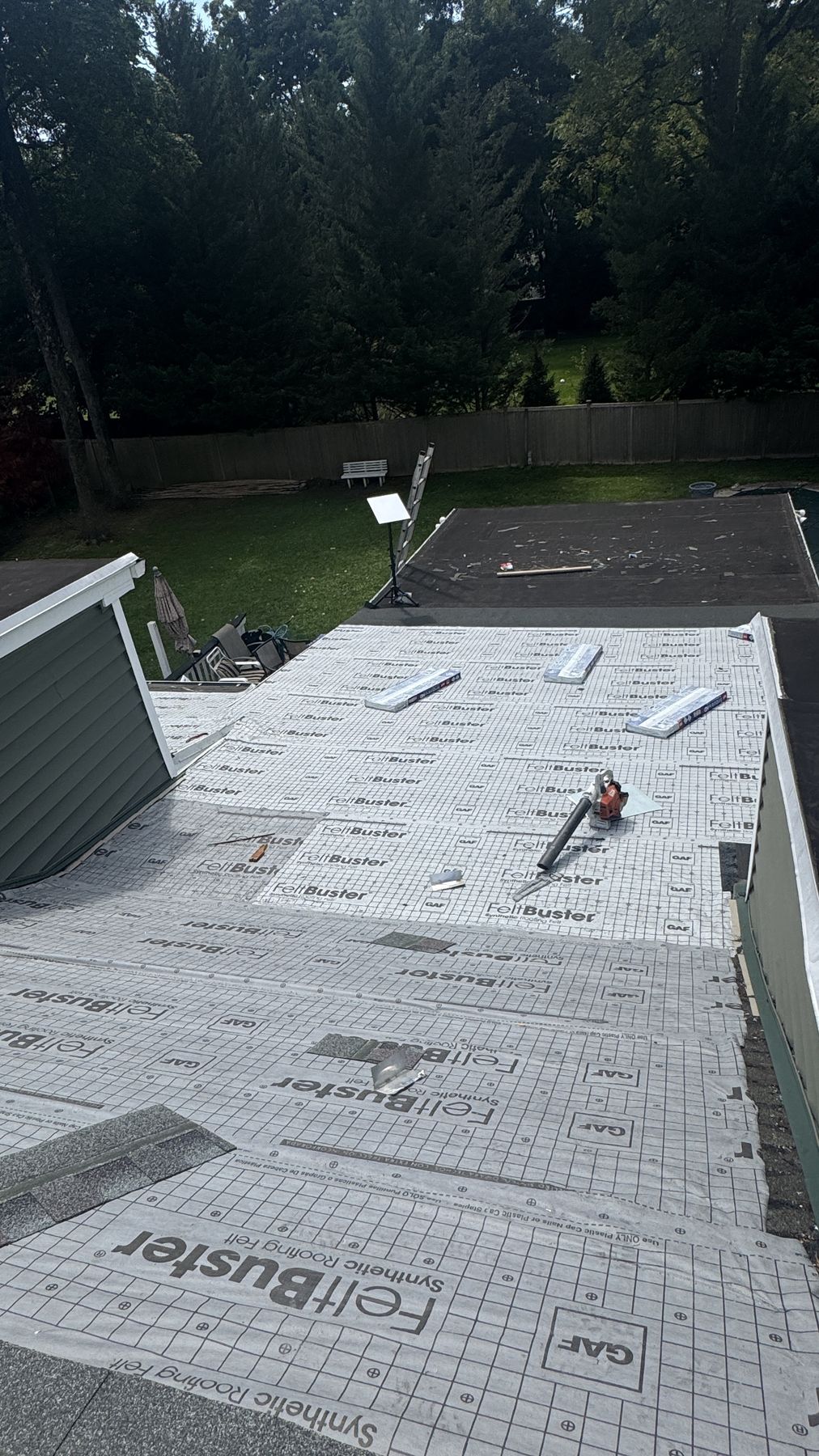
Roof secured and fully dried in the same day, ahead of incoming weather.
What decides the price of emergency roof repair
Nobody likes calling for a price without knowing how it works. Here is what drives it. You get a flat number before work starts — never an open hourly meter.
Your price depends on what we find on the roof, and you hear it before we start.
Emergency roof repair across North Jersey
We cover Morris, Somerset, Essex, Passaic, and Bergen counties. Towns where we work most often:
Storm just came through? The storm damage and insurance claim page walks through documenting damage and working with your adjuster. Not urgent? See all roofing, chimney, siding, and gutter services.
Emergency roof repair questions
What counts as a roofing emergency?
Water actively entering the house, a tree or branch through the roof, shingles or a section of roof blown off, or flashing torn loose with rain in the forecast. If water is coming in right now, that is an emergency. A worn roof with no active leak is not — that can wait for a normal appointment, and you should not pay emergency pricing for it.
How fast can you get to my house?
For active leaks in Morris, Somerset, Essex, Passaic, and Bergen counties we aim to have a tarp on the roof the same day, and most calls placed before mid-afternoon get same-day service. During a large regional storm every roofer in North Jersey is buried at once, so we work by severity: water entering living space first, then exposed decking, then cosmetic damage.
How much does emergency roof repair cost in North Jersey?
Emergency tarping depends on roof pitch, height, and how much area has to be covered, and the permanent repair depends on what we find once the roof is dry. Tree impact or structural decking damage is quoted separately after we see it. We give you a flat number before we start, not an hourly rate that grows.
Will my homeowners insurance cover an emergency roof repair?
Sudden, accidental damage from wind, hail, or a falling tree is usually covered. Damage from long-term wear, age, or deferred maintenance usually is not. Most policies also require you to take reasonable steps to prevent further damage, which is exactly what emergency tarping is, and that emergency cost is often reimbursable. Photograph everything before anything gets moved or covered, and keep every receipt.
Do I need a permit for an emergency roof repair in New Jersey?
For repair work and for a standard reroof on a detached one- or two-family home, usually not. Since March 2018 the New Jersey Department of Community Affairs classifies standard reroofing on those homes as ordinary maintenance, which is exempt from the construction permit requirement. Permits are still required for structural repairs to rafters or decking framing, and for attached homes, condos, multi-family with three or more units, and commercial buildings.
Can you tarp the roof today and do the real repair later?
Yes, and that is usually the right sequence. Getting the house dry stops the damage from spreading into insulation, drywall, and framing. Once the roof is dry and the weather cooperates we come back, open up the area, and make the permanent repair. Chasing a permanent fix in driving rain produces a repair that fails.
Do you work on chimney leaks and flashing?
Yes. Chimney flashing is one of the most common sources of a leak that looks like a roof failure. So are pipe boots, skylight curbs, valleys, and step flashing along dormer walls. We find the actual entry point rather than shingling over the symptom, because water frequently enters several feet away from where it shows up on your ceiling.
Water coming in? Call now.
Every hour a roof stays open costs you insulation, drywall, and framing. We answer the phone seven days a week and we will tell you honestly whether you need us today or whether it can wait.
201-396-5509American Sons Professionals · Licensed & insured in New Jersey · NJ HIC #13VH09666100