Seven signs of storm damage you can check from the ground
You do not need to climb anything to find most of this. Stay off the roof — that is what we are for.
Missing, lifted, or curled shingles
Wind does not have to tear a shingle off to break its seal. A shingle that lifts and lays back down is still compromised and will leak in the next storm.
Granules in the gutters or at the downspout
Heavy granule loss after a hail or wind event means the shingle surface has been stripped. Those granules are the shingle’s UV protection, and without them the mat degrades fast.
Dents or dings on gutters, flashing, and vents
Soft metal shows hail before shingles do. If your gutter aprons and vent caps are pocked, the roof almost certainly took the same hit.
A ridge line that looks wavy or uneven
Can indicate lifted decking or compromised framing from wind uplift or an impact. This one is worth a call the same week.
Debris, branch strikes, or scuff marks on the roof
Even a branch that bounced off can fracture a shingle or puncture the mat without leaving an obvious hole.
Daylight, damp sheathing, or dark staining in the attic
Go up with a flashlight on a dry day. Daylight through the deck is a direct finding. Dark rings on rafters mean water has been getting in, possibly for a while.
Siding, fence, or deck damage on the same elevation
If the wind was strong enough to mark the siding on the west face, the west roof slope took the same wind. Adjusters look at this correlation too.
Seeing any of these? Call 201-396-5509 for a free inspection. Wind and hail damage often does not leak in the first season — and by the time it does, the storm date may be too far back to claim.
The storm damage claim process, step by step
Most homeowners lose money on a storm claim in the first 48 hours, before an adjuster ever shows up. Here is the order that protects you.
Document before anything is touched
Photograph the roof from the ground, the gutters, the siding, the yard debris, and anything damaged inside. Note the date of the storm. If you have to tarp first for safety, photograph first, then tarp, and keep the tarping receipt.
Get an independent inspection before you call it in
A roofer who has been on the roof can tell you whether the damage is above or below your deductible. Filing a claim that gets denied or that comes in under your deductible still goes on your loss history. Knowing first is free.
Report the loss promptly
Policies require prompt notice, and many contain a suit limitation clause that is shorter than people expect. Report it, get a claim number, and write down who you spoke to and when.
Do not sign away your benefits
Do not sign an assignment of benefits, and do not sign a contract that locks you to a roofer before the claim decision comes back. Storm-chasing crews go door to door in North Jersey after every major wind event with exactly these forms.
Meet the adjuster on the roof — with your roofer there
This is the step that decides your money. An adjuster working fast across a whole county can miss slopes, undercount squares, or leave out flashing, underlayment, drip edge, and disposal. Having a contractor on the roof at the same time with photos and a written scope means those items get discussed in person instead of disputed on paper later.
Compare the scope to the estimate, and ask about what is missing
If the insurer’s scope leaves out work that is genuinely required, a supplement can be submitted with documentation. If you want someone to argue the claim itself on your behalf, that is a licensed New Jersey public adjuster’s job — not a roofer’s.
What we do — and what we will not pretend to do
What we do
- Free, no-obligation roof inspection after a storm
- Full photographic documentation of every slope
- A detailed written scope and estimate of the damage
- Meet your adjuster on the roof so nothing gets missed
- Emergency tarping to stop further damage
- Repair or full replacement once the claim is settled
- An honest opinion on whether to file at all
What we will not do
- Negotiate or adjust your claim — in New Jersey that requires a public adjuster license from the Department of Banking and Insurance
- Ask you to sign an assignment of benefits
- Offer to “cover your deductible” — that is insurance fraud, and it is how homeowners get dragged into it
- Pressure you to sign before your claim decision comes back
- Invent damage that is not there
Storm damage replacement, done properly
A North Jersey roof going back on after storm damage: stripped to the deck, dried in, new drip edge and gutter apron set, and architectural shingles racked and nailed to spec. Storm work is where corners get cut most often, because the homeowner is stressed and the insurer is paying. We build it the same way whether you are paying or your carrier is.
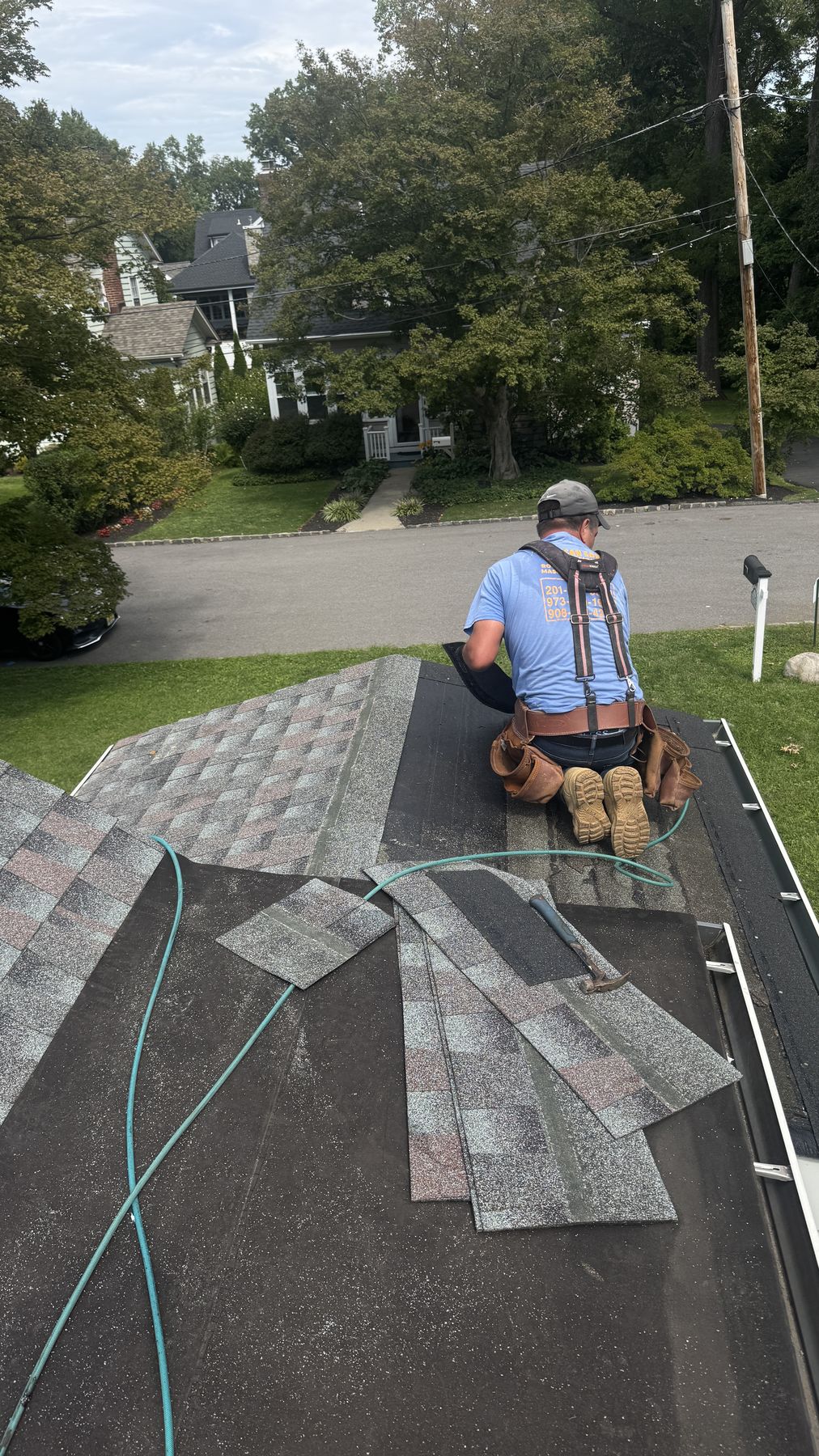
New architectural shingles going on over a fully dried-in deck after storm damage.
What actually damages roofs in North Jersey
We are not a hail alley, and any contractor selling you a hail claim after every drizzle is selling you something. What genuinely takes roofs apart here is different.
Nor’easters and summer downbursts drive sustained wind against the same slope for hours, breaking shingle seals across whole elevations. Tree fall is our biggest single cause of catastrophic roof damage — Morris and Somerset counties are heavily wooded, and mature oaks come down on saturated ground in high wind. Ice damming during freeze-thaw cycles pushes water backward under shingles and into the wall cavity, and it is a ventilation problem as much as a weather problem.
Because most of this damage does not leak immediately, homeowners find it a year later during a sale inspection — long after the storm date that would have supported the claim. That is the real cost of waiting.
Free storm damage inspections across North Jersey
Morris, Somerset, Essex, Passaic, and Bergen counties. Towns where we work most often:
Water coming in right now? Go to emergency roof repair instead — that gets a same-day response. Otherwise, see all our services or learn who we are.
Storm damage and insurance questions
How do I know if my roof has storm damage?
From the ground, look for shingles missing or lifted, granules collecting at the bottom of downspouts, dented or dinged gutters and flashing, a ridge line that looks uneven, and debris or branch strikes on the roof. Inside, check the attic with a flashlight for daylight, damp sheathing, or dark staining on rafters. Hail and wind damage frequently cause no leak at all in the first season, which is why so many claims get missed until the damage is no longer coverable.
Does homeowners insurance cover storm damage to a roof in New Jersey?
Typically yes for sudden, accidental damage from wind, hail, or falling trees. Typically no for damage from age, general wear, or deferred maintenance. Many New Jersey policies also carry a separate, higher windstorm or hurricane deductible that is calculated as a percentage of the dwelling coverage rather than a flat dollar amount. Read your declarations page for that number before you assume what you will owe.
How long do I have to file a storm damage claim in New Jersey?
Most homeowner policies require prompt notice of loss, and many contain a suit limitation clause that restricts how long you have to bring an action against the insurer. Those windows are shorter than people expect. Do not wait through a season to report damage. Report it, get it documented, and let the insurer decide.
Should I file a claim or just pay out of pocket?
It depends on the size of the damage relative to your deductible. If the repair is plainly below your wind or hurricane deductible, a claim gains you nothing and still appears in your loss history. If the damage is significant or the roof needs replacement, a claim usually makes sense. We will give you our honest read after we get on the roof, including when we think you should not file.
Do you handle the insurance claim for me?
No, and you should be cautious of any contractor who says they do. In New Jersey, negotiating or adjusting a claim on a homeowner’s behalf requires a public adjuster license from the Department of Banking and Insurance. What we do is the contractor’s part: a full documented inspection with photographs, a detailed written scope and estimate of the damage, and meeting your adjuster on the roof so nothing gets missed. You stay in control of your own claim.
Should I sign a contract before the insurance company approves the claim?
Be careful. Do not sign anything that assigns your insurance benefits to a contractor, and do not sign a contract that binds you to a roofer before you know what the insurer has approved. A legitimate roofer will inspect and document at no charge and wait for the claim decision. Anyone pressuring you to sign on the first visit, especially a crew that knocked on your door after a storm, is a reason to slow down.
Do I need a permit to replace a storm damaged roof in New Jersey?
For a standard reroof on a detached one- or two-family home, usually not. Since March 2018 the New Jersey Department of Community Affairs classifies that work as ordinary maintenance, which is exempt from the construction permit requirement. Permits are still required for structural repairs to rafters or decking framing, and for attached homes, condos, multi-family with three or more units, and commercial buildings.
What if my insurer approves a repair but the roof really needs replacing?
This is common, especially when damage is spread across multiple slopes or when the existing shingle is discontinued and cannot be matched. Your policy language and your state’s matching rules matter here. We provide photographic documentation and a written scope showing what we actually found, which is what you need in front of the adjuster. If you want someone to argue the claim itself, that is what a licensed New Jersey public adjuster does.
This page is general information about roofing and the claim process, not legal or insurance advice. Coverage depends on your specific policy. For questions about your claim, contact your insurer or a New Jersey licensed public adjuster.
Get the roof looked at before the storm date runs out
Free inspection, full photo report, written scope. No obligation, no pressure, and a straight answer about whether filing is even worth it.
201-396-5509American Sons Professionals · Licensed & insured in New Jersey · NJ HIC #13VH09666100